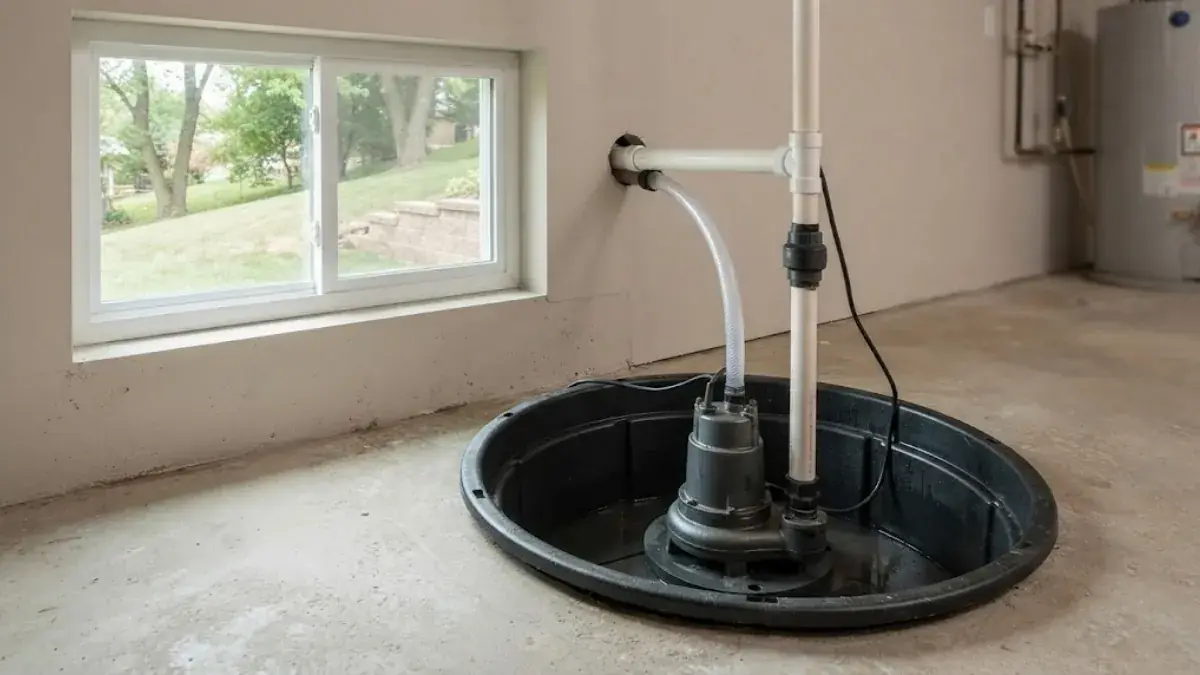
How a sump system works
- Water collects in a pit, called the sump basin, set into the floor of a basement or crawlspace.
- A float switch or sensor rises with the water and turns the pump on.
- The pump pushes the water up and out through a discharge pipe to the outside, away from the foundation.
- A check valve in the discharge line keeps water from flowing back into the pit.
Every part has to work. A pump with a clogged discharge line or a stuck float will not protect the house.
Does your house need one?
- Water on the floor after heavy rain. Seepage through walls or floor joints is the classic sign.
- A damp or musty basement or crawlspace. Moisture feeds mold and rot.
- A low lot or a slope toward the house. Runoff collects at the foundation.
- Past water damage. If it has happened, it can happen again.
Grading and gutters help first. If water still reaches the foundation, a sump system adds a mechanical layer.
What installation involves
| Step | What happens |
|---|---|
| Evaluate | We look at where water enters and how it flows around the foundation |
| Choose the pump | Submersible or pedestal, sized to the water volume |
| Dig the pit and set the basin | A hole is cut in the floor and a basin installed |
| Install the pump and discharge | Float, check valve and pipe to an outlet away from the house |
| Test | Fill the basin and confirm the pump starts and stops |
A discharge pipe should empty well away from the foundation, not onto a neighbor's property or into a sewer line. Discharging into the sanitary sewer is not allowed in many places, so ask the building department.
Backup power and failure protection
Sump pumps fail when the power goes out, usually during the storm that fills the pit. A battery backup pump or a water-powered backup keeps the system working through an outage. A high-water alarm warns you before water reaches the floor.
Test the pump twice a year by pouring water into the pit until the float rises. Clean the inlet screen and check the discharge for ice, debris or kinks. A sump pump that has never been tested is a gamble.
What affects the cost
Pump types and what suits a house
| Type | Strengths | Trade-offs |
|---|---|---|
| Submersible pump | Sits in the pit, quiet, handles more water | Harder to service, costs more |
| Pedestal pump | Motor sits above the pit, easier to service | Louder, takes more space |
| Battery backup pump | Works during power outages | Needs battery maintenance |
| Water-powered backup | No battery or power needed | Needs municipal water pressure and uses water |
The right choice depends on how much water you expect, how finished the space is and how much noise you can live with.
Habits that keep it working
- Test twice a year. Fill the pit and watch the pump cycle.
- Clean the pit. Silt and debris foul the float and the pump.
- Check the discharge outlet. Make sure it is clear and drains away from the house.
- Keep a spare. A backup pump saves a crisis if the main one fails.
Before you call a plumber
- Note where and when water appears: after what kind of rain, and along which wall.
- Photograph the area, including stains and tide lines on walls.
- Check gutters and downspouts. Water dumped beside the foundation causes many wet basements.
- Look at the grade. The ground should slope away from the house.
- Tell the plumber about past repairs or any sealing work already done.
Simple fixes outside the house sometimes solve the problem. A plumber will tell you when a pump is the right answer and when grading and gutters are.
Bessemer note: permits and where the water goes
Check with Bessemer Building Inspections at (205) 424-4060 on whether a permit applies and where a discharge may go. Do not tie a sump pump into the sanitary sewer unless the department confirms it is allowed. Rules differ by jurisdiction, so homeowners in other cities should call their own office.
Source type: City building inspections guidance
Neighbors in Hueytown and Hoover should confirm local rules as well.
Sump pump questions
Away from the foundation, to a safe outlet on your property. Do not connect it to the sanitary sewer unless the local office confirms it is allowed.
Many last several years, depending on use. Test it regularly and replace it if it is old or noisy.
It is wise if the pump protects a finished space or valuables. Outages often come with storms.
No. It handles groundwater in the pit. Grading, gutters and sealing also matter.
Stagnant water in the pit can smell. A sealed lid and a working pump help.