Step one: prove a leak exists
The first tests are simple. A meter test shows whether water moves with everything off. A pressure test isolates a section of line, closes it and watches whether the gauge drops. These tests do not find the location. They tell the plumber whether the leak is on the supply side, the drain side or somewhere in between.
Isolating lines also helps. Hot and cold are tested separately, and so are individual branches, so the search area shrinks.
The tools, side by side
| Tool | How it works | Best for |
|---|---|---|
| Acoustic listener | Microphones pick up the sound of water escaping from a pressurized pipe | Slab leaks, buried lines |
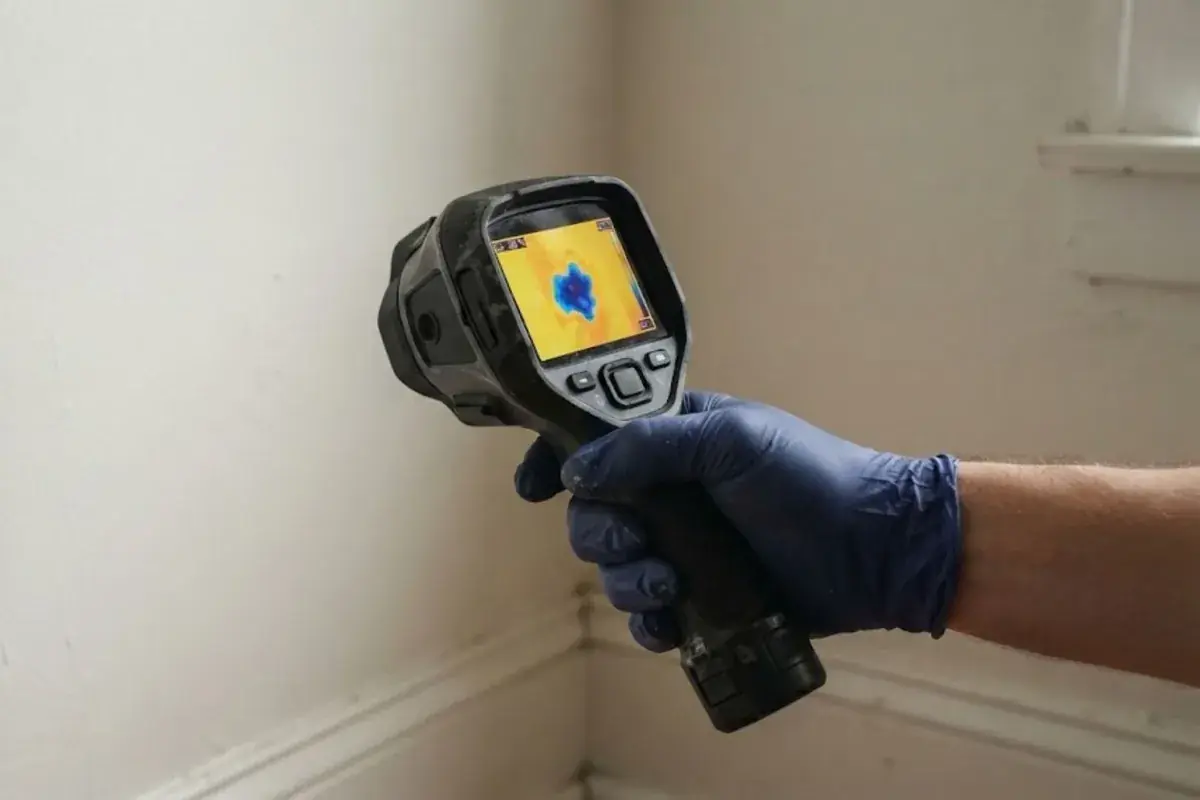
| Thermal camera | Shows temperature differences from damp or heated areas | Hot water leaks, wet walls, radiant lines |
| Moisture meter | Measures moisture in building material | Walls, ceilings, floors |
| Pipe locator | Traces a pipe's route with a signal | Buried lines and slab runs |
| Tracer gas | A harmless gas is added to the line and detected where it escapes | Hard-to-find leaks |
| Sewer camera | A camera runs through a drain line | Drain and sewer leaks, cracks |
Each tool answers a different question. A plumber who uses only one tool is guessing at the rest.
How the pieces come together
- Pressure and meter tests narrow the leak to one line.
- Listening gear identifies the loudest spot along the line.
- A locator ties that spot to a pipe run.
- A thermal camera or moisture meter confirms what the sound suggests.
- The plumber marks the spot and explains the repair.
Only then is anything cut. The goal is the smallest opening that reaches the leak.
What leak detection cannot do
- It cannot see through everything. Noise from traffic, other pipes or running appliances can hide a leak sound.
- It does not fix the leak. Detection and repair are separate steps, and repair is quoted once the leak is found.
- It cannot always be exact. A well-done search finds the area, and confirming steps reduce the error.
- It is not instant. Complex leaks can take time to isolate.
A good plumber is honest about uncertainty. If a tool gives mixed signals, they say so and use another.
Drain and sewer leaks
Supply leaks are under pressure, and drain leaks are not, so the tools differ. A camera run through the drain shows cracks, offset joints and root intrusion. In some cases a smoke or dye test traces where wastewater escapes. See sewer inspection for what the video shows.
If wet soil or odor outside the house suggests a sewer leak, mention it when you call so the plumber brings the right equipment.
What to do before the plumber arrives
- Take a meter reading. Write down the number and the time.
- List the signs. Where is it warm, wet, stained or noisy.
- Keep the house quiet. Turn off appliances, fans and the dishwasher so listening is easier.
- Know your shutoff. Show the plumber where it is.
Why the order of tests matters
Plumbers who skip the proving step waste time. If the meter does not move, you may not have a leak at all, and the sound the homeowner heard may be a toilet, an ice maker or a pressure regulator. If the meter does move, the next tests narrow the search by line and zone. The order saves money, because a cheap test early avoids an expensive search later.
It also protects your house. Cutting a wall because a camera showed a warm patch, without confirming with a pressure test, risks a hole in the wrong place. A good plumber treats cutting as the last step.
Bessemer note: asking your utility
Your water utility knows when pressure or consumption changes in your area, and it may be able to help you confirm a leak on its side of the meter. If a repair needs a permit, Bessemer Building Inspections handles it at (205) 424-4060. We do not state utility policies from memory, so ask your utility directly.
Source type: Utility customer information and city building inspections guidance
Homeowners in Pleasant Grove and Fairfield can book the same leak detection visit.
How leak detection works: your questions
Not usually. The tools work from the surface, and cutting only happens once the leak is located.
It is good at narrowing a leak to a small area, especially when combined with other tests.
A harmless gas added to a line that is detected at the point it escapes. It helps when other tools are inconclusive.
Many take one to a few hours, depending on the size of the house and the complexity.
No. Detection finds the leak and repair fixes it. We quote the repair once the source is known.